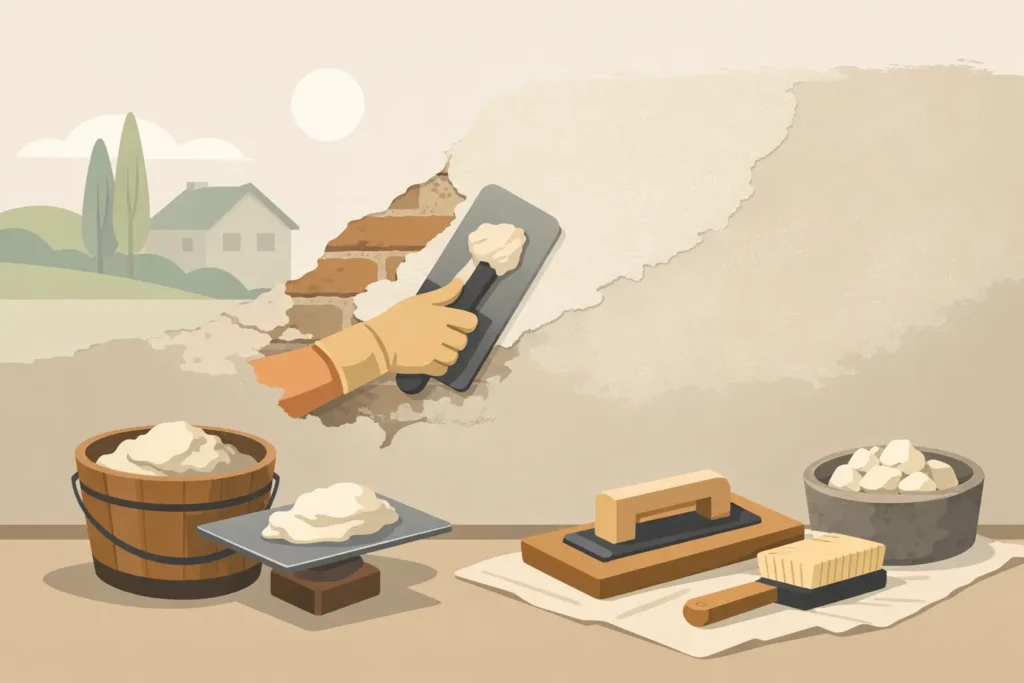
A hairline crack across an old wall is not always a reason to strip everything back. Equally, a patch of loose, hollow-sounding plaster should never be covered over and forgotten. Traditional lime plaster repair is about understanding how an older wall was built, where moisture is travelling and which areas genuinely need attention. The right repair protects the character of the property while giving the finish the strength and durability it needs.
Lime plaster is common in period homes across Dorset, particularly on solid brick, stone and lath-and-plaster walls. Unlike modern gypsum plaster and cement-rich coatings, it is designed to be slightly flexible and vapour permeable. That means it allows a building to manage small amounts of moisture rather than trapping it within the wall.
Why traditional lime plaster fails
Cracks and blown plaster are usually symptoms, not the whole problem. Natural movement in an older building can create fine cracking, especially around openings, ceiling lines and junctions between different materials. Small cracks may be cosmetic, but larger, widening or repeated cracks need a closer look before any plastering begins.
Moisture is a more frequent cause of failure. Defective gutters, cracked render, leaking pipework, high external ground levels and poor ventilation can all allow water into a wall. Salts can then build up beneath the plaster, while repeated wetting and drying causes it to lose its bond. On timber laths, prolonged damp may also weaken the laths or corrode the fixings holding them in place.
Inappropriate previous repairs are another common issue. Hard cement patches and non-breathable masonry paint can prevent moisture from evaporating through an old wall. The moisture may then move elsewhere, leaving surrounding lime plaster damp, crumbly or detached. Replacing a failed lime patch with more cement can make the immediate area look tidy, but it often transfers the problem rather than solving it.
Traditional lime plaster repair starts with diagnosis
A careful inspection should establish whether the plaster is still sound. Gentle tapping can identify hollow areas, while visual checks reveal cracking, staining, bulging and powdering surfaces. The condition of external walls, rainwater goods, roof coverings and internal plumbing should be considered at the same time. There is little value in repairing internal plaster before the source of water ingress has been resolved.
Where the plaster is firm, dry and well bonded, conserving it is normally the best option. Fine cracks can often be opened slightly, cleaned and filled with a compatible lime-based material. Localised loose areas may be carefully cut back to a stable edge and repaired without disturbing an entire wall.
If broad areas have detached, the repair may need to extend further. On lath-and-plaster ceilings, the contractor should assess the laths, keys and fixings before deciding whether sections can be secured and repaired or whether replacement is safer. A sagging ceiling, heavy movement or widespread failure should be treated cautiously. Protecting occupants and retaining a sound structure comes before preserving every fragment of original finish.
For listed buildings or homes in conservation areas, the scope of work may also require specialist advice or formal consent. Retaining historic fabric where practical is generally preferable, but each wall needs to be judged on its condition rather than a fixed rule.
Choosing the right lime for the wall
There is no single lime plaster mix that suits every property. The existing background, exposure of the wall and finish required all influence the choice. A traditional lime putty plaster is often used internally where a softer, fine finish is appropriate. Hydraulic lime may be selected where a little earlier strength or greater resistance to damp conditions is needed, although it must not be stronger than the background it is being applied to.
The principle is straightforward: the new repair should be compatible with the old wall. It should not be harder, less breathable or more rigid than the material around it. Aggregate choice matters too. Well-graded sand helps achieve the correct texture, workability and shrinkage control, while matching the existing finish can make a repaired area far less noticeable.
Premixed products can offer consistency, particularly for smaller repairs, but they still need to be chosen correctly. A durable result comes from suitable materials, careful preparation and appropriate curing – not simply from buying the strongest product available.
How a proper repair is carried out
The work begins by protecting adjoining floors, joinery and fittings, then removing only the plaster that has failed. Loose material is cut back to a stable edge using controlled methods that avoid damaging brickwork, stone or timber laths behind. Any dust, salts and friable debris must be removed so the repair has a clean, sound background.
The exposed area is then assessed and prepared. Masonry may need light dampening before plaster is applied, especially in warm or dry conditions. This prevents the wall drawing water out of fresh lime too quickly. Timber laths should be checked for movement and decay, with damaged sections repaired or renewed as necessary.
Lime plaster is generally built up in coats rather than applied as one thick layer. A base coat is pressed firmly into the background or through the laths to create a mechanical key. Once it has firmed sufficiently, further coats are applied to bring the repair level with the surrounding wall. Each stage requires time to set and dry at its own pace.
Curing is where good workmanship is often most visible. Fresh lime plaster needs protection from rapid drying, direct heat and frost. A room that is over-heated to speed up the programme can cause shrinkage cracks and weaken the finish. Sensible ventilation, moderate temperatures and patience produce a better repair than forced drying ever will.
The final surface can be finished to suit the room, from a lightly textured traditional appearance to a finer, more even finish. If decoration is planned, breathable paint systems are normally the right choice. Non-breathable vinyl paints can restrict the benefits of the lime repair and may lead to future peeling or damp marks.
When a small repair becomes a wider project
It depends on what the investigation finds. Local cracking around a doorway may only need targeted repair and decoration. Widespread damp staining, repeated blown patches or a wall coated in hard cement may point to a larger programme involving external repairs, ventilation improvements or removal of unsuitable finishes.
This is where coordinated building knowledge makes a difference. A plaster repair may sit alongside roof work, replacement rainwater goods, structural alterations, insulation upgrades or a full renovation. Addressing these elements in the right order avoids paying for a finish that is later disturbed or damaged.
For homeowners planning wider work in Bournemouth, Poole or across Dorset, a contractor should explain the likely cause, the proposed repair build-up and any work needed to protect it. Clear communication about drying time is also essential. Lime work does not always fit the same timetable as modern plastering, but allowing for that process is part of achieving a lasting result.
Looking after repaired lime plaster
Once the repair has cured, keep an eye on the building rather than just the wall surface. Clear gutters, sound pointing, good drainage and prompt attention to leaks are among the best ways to protect internal finishes. Avoid sealing old solid walls with impermeable coatings unless there is a clear technical reason to do so.
Small defects are usually simpler and more economical to resolve before damp or detachment spreads. If a crack changes, plaster begins to bulge, or staining returns after decoration, have the cause checked rather than repeatedly filling the visible mark.
A well-executed lime repair should sit quietly within the fabric of the home: breathable, carefully finished and ready to serve the building for years. Taking time to diagnose the wall first is the soundest investment in that outcome.